When the only pharmacy in town closes: a one-pager for rural pharmacy owners

Press fast forward spelled on Scrabble pieces.
I help mid-career researchers develop sustainable, impactful research programs designed for the next phase of their careers. Click here to find out more.
Use AI tools to help you fast-track your communication strategy with community partners, organizations, and decision-makers. Leverage your audience profile to create compelling infographics today.
Last week, I corrected an oversight in a previous post on using AI to fast-track impactful science communication by walking through how to develop an audience profile. As you might recall, I created a profile of rural community pharmacy owners. Click this link to see the whole profile.
This week, we’ll use that profile and ask Claude to develop communications based on my previous work examining the financial viability of rural community pharmacy owners.
The prompt
Here’s the prompt I used:
Using the audience profile for rural pharmacy owners, create a 1-page infographic with talking points summarizing the current literature on the impact of pharmacy benefit manager (PBM)- related legislation on rural community pharmacy practice and patient outcomes.
Please keep in mind that I have not yet updated or modified the profile created last week (we needed additional data to strengthen it).
The 1-pager
Below is the 1-pager created from the prompt.
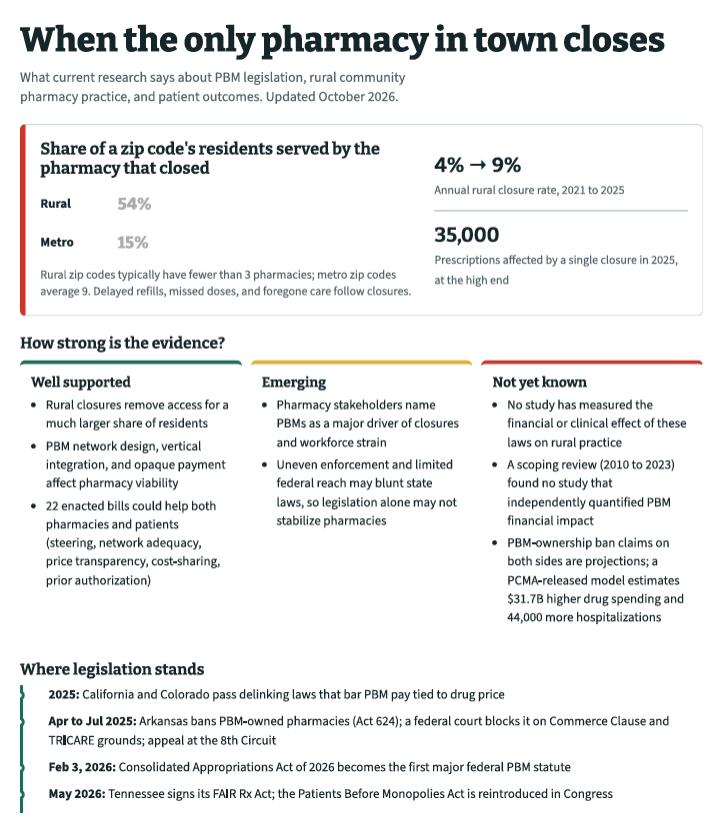
What I like:
- It starts with patient access, per the recommendation from the previous profile. Patient access is compelling for providers and legislators.
- The language is straightforward and to the point. YAY brevity!
What needs some work:
- I like the color coding on the evidence (green = good, red = needs work), but the repetition of those colors in other parts of the document could be confusing.
- Depending on the pharmacist population I was working with, I might update the current legislation list to be more state- or region-specific.
Talking points
The talking points I asked Claude for are listed below.
1. Lead with access
a. One closure in a rural zip code reaches over half its residents. In a metro zip code, it is 15%. Local pharmacies are the last access point.
2. Name the provisions that matter
a. Push for steering limits, network adequacy, pricing transparency, fairer cost-sharing, and simpler prior authorization. These categories tie to benefits for both pharmacies and patients.
3. A law on paper is not relief
a. Ask legislators and your state board how rules will be enforced and how complaints get resolved. Evidence suggests that uneven enforcement limits results.
4. Be straight about the evidence
a. Impact data on rural practice is thin. Your own records (reimbursement against acquisition cost, refill gaps, nearby closures) help fill that gap.
What I like:
- They are brief and don’t contain any academic jargon.
- They are action-oriented.
- They feel realistic with respect to the data we have right now.
References
Here are the references Claude provided to back up the 1-pager and the talking points.
Sources: IQVIA, "Pharmacies as Pillars of Rural Health Outcomes" (Jul 2026); Exploratory Research in Clinical and Social Pharmacy, content analysis of state PBM laws (2025, DOI 10.1016/j.rcsop.2025.100595); Health Affairs Scholar, state PBM laws 2015 to 2025 and stakeholder perceptions (2026); scoping review of PBM impact on community pharmacy finances (PMC10276176); PCMA release on Bhai analysis (Mar 2026); court and policy summaries on Arkansas Act 624, Consolidated Appropriations Act 2026, and Tennessee FAIR Rx Act. Litigation and legislation change quickly; verify current status before citing.
Final thoughts
I’ve made 1-pagers before, and it has taken me hours to winnow the data into a few talking points that are always too wordy and generally only relevant to other academics. I think it took me an hour to create the basic audience profile and 20 minutes to create the materials presented in this post today. This document isn't perfect, but it is a start, has a clear message, and could help me take the next step toward getting rural community pharmacies on board with solidifying rural pharmacy practice data today. I’d say that’s pretty good. Thanks, Claude.
(Words: 637)
Not sure what you need? Complete this 3-minute survey to see if I can help.